PIPELINE · SOIL|WATER|SPECIMEN TO CLAIM
Six stages. One verifiable chain of custody.
From a raw FASTA or DwC-A (Darwin Core Archive) through to a published, data-tethered scientific artifact — every step recorded, every claim re-derivable. The same chain runs under the BioKEA molecular sequencing service, so customer samples land with the same verifiable output as our own.
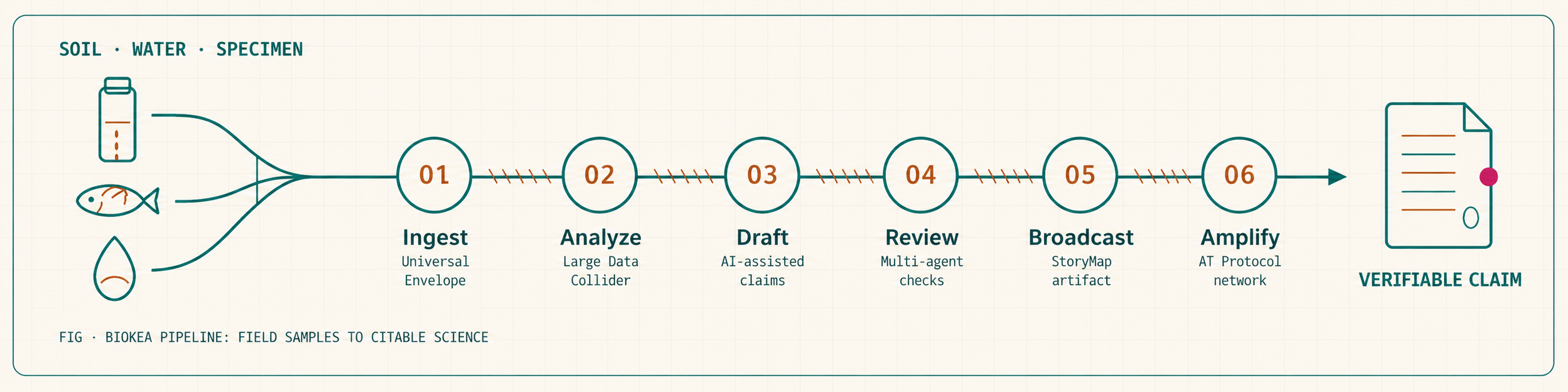
- 01IngestUniversal Envelope
Every input — raw FASTA, DwC-A archive, drafted manuscript — becomes a cryptographically trackable object. Automatic file-type detection and metadata extraction.
- 02AnalyzeLarge Data Collider
The LDC runs image QC, taxonomy reconciliation, and FAIR validation over millions of reads in minutes. Outputs operational taxonomic units and candidate novel lineages.
- 03DraftAI-assisted narrative
The scientist directs; the AI drafts structure and links LDC data directly into the text. Cross-references with external hypotheses in real time.
- 04ReviewMulti-agent panel
AI pre-screens manuscript structure and methodology in hours. Verified human experts evaluate contextual scientific nuance. Weighted, transparent scoring.
- 05BroadcastInteractive StoryMap
The end product is not a dead PDF. It is an explorable digital artifact permanently tethered to its underlying FAIR data package (GBIF, NCBI SRA, Zenodo).
- 06AmplifyPress · human-approved
Publishing is the starting line, not the finish. Once a result is live, Press can coordinate a human-approved, platform-neutral share campaign for that release — never automatically, and only after publication.
COMPUTE ENGINE
BioInfoOS
The software layer running on the BioKEA Large Data Collider (LDC) — and, as part of BioKEA Works, a compute product approved researchers can use directly. In-house AI-assisted modules cover:
- · Extraction-run QC (Claude Vision over plate images)
- · Taxonomy reconciliation against BOLD, NCBI, and GBIF
- · FAIR (Findable, Accessible, Interoperable, Reusable) package validation — DwC-A, Darwin Core, Zenodo DOI-ready
- · Draft narrative generation tethered to pipeline outputs
- · Operational Taxonomic Unit (OTU) clustering, amplicon denoising, and chimera filtering
Modules ship incrementally; BioInfoOS is in closed-testing alpha and runs on the same LDC hardware used by the molecular sequencing service.
See BioInfoOS in BioKEA Works →PUBLISHED VIA
Press
Pipeline outputs publish through Press, part of the BioKEA Works suite — submission, peer review, and public release, including Agentis, an evidence-backed review capability. In closed-testing alpha.
See Press in BioKEA Works →TRUST
Cryptographic provenance, end to end.
Every artifact carries a verifiable record of exactly how it was produced — a Result Manifest. Every peer review is a signed, verifiable record. The pipeline doesn't just produce findings — it produces evidence that's re-derivable from raw input to published claim, by anyone, at any time.

Want to plug a sample into this?
We're onboarding sample streams and collaboration partners.